Submissions (13)

yan57436's avatar
yan5743611/14/2024

$5

Engineering is something you'll have to understand at some point in your elite dangerous gameplay, it's what will allow you to modify the modules of your ships and adapt them to suit your style of play. Here I'll help you with what I can

What it is: Basically engineering consists of you improving your ship's modules with specific modifications, these modifications are made by engineers (we have several and each with their own specialization). You'll improve abilities such as jump range, shield resistance, basically make your ship more effective, making it indispensable for the late game. But it's not because it's essential in the late game that you don't need to worry about it in the early game.

Choosing an engineer: As I said, each engineer will have some specific improvements and requirements to be unlocked, the ones I like the most are Felicity Farseer, who specializes in Frame Shift Drives, and The Dweller, who specializes in power distribution.

Good processes: I tell you that the best way is to evolve little by little, since it is very laborious and expensive, try to reach grade 3 in the main modules before jumping to 5. When you have reached the maximum grade, we will have experimental effects, which are the most unique, but very expensive, plan what you are going to do, remember to do a good management of materials, such as raw, manufactured and coded materials.

Engineering and equipment: How do they work together?

The engineering complements the equipment, as it will allow you to customize the modules beyond the standard. Plan the equipment with engineering in mind to maximize the potential of each module without overloading the power system or the weight of the ship.

Dydo's avatar
Dydo11/14/2024

$5

Engineering: a road to success

As mastercesspit said here, “if it's not engineered, it's not worth flying, o7.”


The Basics

Engineering is a powerful game mechanic that allows Commanders to improve their modules with various modifications, depending on the Engineer they visit. It’s simple to understand: you build a reputation with them, provide the necessary materials, and they’ll modify your modules.

Since these Engineers are unique individuals in the galaxy, you first need to know about their existence. Some are common knowledge, while others require additional actions to discover, like traveling a certain number of Ly. Once discovered, you’ll be asked to bring a small contribution, like commodities or materials, to gain access. Each Engineer specializes in specific modules, so it’s helpful to know exactly which Engineers to seek out based on your goals in the galaxy. A Miner, for example, will need different modifications than a Bounty Hunter.

They’re also only found on planetary surfaces, so you’ll need a Planetary Approach Suite to dock at their bases. To strengthen relationships with Engineers, it’s best to sell commodities or exploration data, though you can also improve relations simply by applying module modifications.


Modifications nuances

Each modification has 5 levels (grades), improving specific aspects of the module while negatively affecting others, requiring you to balance the drawbacks. For example, enhancing the power output of a Power Generator reduces its Heat Efficiency, meaning you can use a smaller, lighter module, but you’ll need to be cautious in high-heat situations, such as landing on high-gravity planets (>2g) or using the Fuel Scoop for extended periods. In that case, carrying a Heat Sinker can help, but other modifications, like those to the Power Distributor, may require you to prioritize one system at the expense of others (Weapons vs. System and Engine), requiring more attentive management. Or you can simply improve your module to the grade you're comfortable with - a full engineered Power Grade that keeps your ship at 40% of Power usage doesn't make sense, right? Also, you can deactivate some modules and reactivate them only when in need, as with the Auto Field-Maintenance Unit (AFMU).

To understand engineering, you need to understand your ship, its modules, their uses, and their possibilities. Technically, you can transform any ship for almost any purpose. However, some ships will naturally have advantages in certain roles. For instance, for exploration, maximizing the potential of the Frame Shift Drive (FSD) is essential to achieve a greater jump range. Additionally, the overall weight of your ship influences its jump capability. And what adds weight to your ship? The modules! Well, most of them, anyway.

Not needing weapons, which would only add unnecessary weight, means you can downgrade certain systems, like Scanners, Life Support, or Heat Sink to reduce weight while keeping them functional enough for exploration. However, you won’t be able to do this alone; you’ll need the right Engineer to help meet your goals. Every Engineer knows the basics of stable buildings, but not all can make a perfectly optimized bridge. Trust me, when well engineered and outfitted, the performance jumps are enormous, taking a 40Ly-range ship to 60–70Ly.

And these gains can be even greater if you apply an experimental effect directly with an engineer. In fact, it’s a good opportunity to mention that you can save one Blueprint per engineer for a module of your choice, allowing you to modify it yourself at any Starport or Drake-Class Carrier up to the grade you unlocked with that specific engineer. However, experimental effects can only be applied directly at the engineer's base, and Remote Workshops do not increase your reputation with the engineer.


Third party engineering tools - use them!

Now that you understand the basics of engineering, you’re ready to choose which Engineers to seek out first. Some organization will be needed, but it’s the year 3310, so there are plenty of tools available to assist. I recommend two:

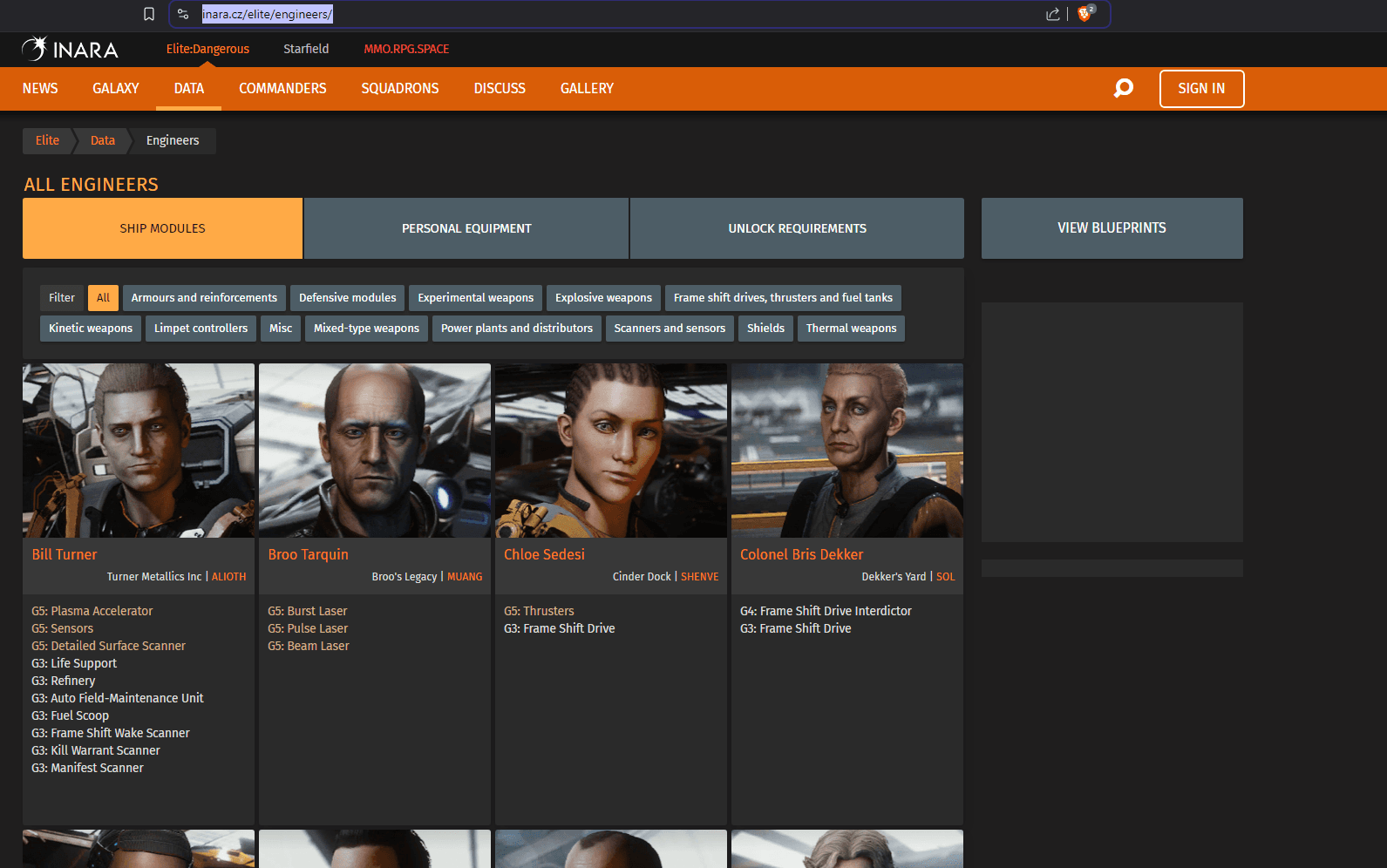
  1. A more general tool is a spreadsheet that gives you access to organized data on which Engineer does which modification, the maximum grade offered, where to find them, and what’s required to access them, and you can access it here (a bit more concise than Inara, which is also worth checking out).

A huge thanks to the Commanders who collaborated to provide us with this resource: Qohen Leth (owner), EfilOne (admin), Arjin Fury, Nexolek, Shellström, Lucienn/Kitsune, Scinaya, KT412, Belthize, TheTick, Alex Brentnall, John Keller, LazerusKI, Athanasius, Justago, BranchesOfSin, Ablative, and eugeniy. Source: Reddit.

  1. The other tool integrates with the game, focusing more on modifications by showing the materials you have or need, which are necessary for a particular modification, the number of modules currently modifiable, and more. This tool is very useful once you’ve organized which Engineers you want to approach – although you’ll likely end up unlocking most of them eventually. Remember to check the tutorial within the Github page, but it's pretty intuitive. By the way, this tool even shows where to find these materials!

Another huge thanks to Commander Maxime Sarilar for developing this fantastic software. This community is incredible!

Verified

There are many other useful tools for a Commander, whatever your preferred career, but these should be sufficient to engineering in my opinion. Remember, practice makes perfect, so pick one engineer and modify your modules with them. But do this only after you understand how each one works and how dynamic the ship's system is, so that you don't waste materials, which can take some time to collect.


The Grind Materials

These materials vary from module to module, so it would be advisable to have a ship outfit on hand to know what materials to gather. One tip is to get the highest quality materials and then trade them with a Material Trader – you can check which stations they’re available at here, or by editing the Advanced Search for this purpose.

There are three types of materials that can be obtained in different ways: Raw Materials, by mining; Manufactured Materials, through salvaging; and Encoded Materials, by scanning ships and other objects. Also, you can get them through missions. Use EDEngineer to know what you need to do and where to get these materials, this way you can do it faster and foccused on what you need right now. There's no need to keep rushing after that - you might never pursue another career again or take a long break before you do - don't let the grind consume you!


Equipment engineering

You may notice that there are actually two types of engineers: those who modify modules and those who modify equipment. The latter are only available if you’re able to play the Odyssey expansion, and they’re particularly useful in on-foot planetary activities. They can enhance your weapons, suit, or equipment, offering utilities like Night Vision or Improved Battery Capacity.

This difference is important because the "materials" are different, and in fact, there are three types again, almost as a correlation: Components (Assets), Goods (Items), and Data (not to be confused with Encoded Materials). They’re relatively easier to obtain because they can be bought for CR on any Concourse's Bartender (disembarking in any Spaceport), acquired in missions, or purchased on Fleet Carriers (check out Inara for this). There’s only one grade for these enhancements, making this process simpler than with modules, though, in my opinion, it should be done afterward the modules.

However, I recommend visiting different Starports and disembarking, as Pioneer Supplies often sells premium equipment – though it's rare – that might save more time than the engineering process. Even though you may lose the personal satisfaction of going through the process of enhancing your equipment - if you’re in a hurry or simply want to enjoy other activities in the galaxy, this could be a better option.


Lastly, consult Inara or the Elite Dangerous Wiki, as there’s a lot of useful and detailed information about engineering there.

Make your ship worth it by engineering it as soon as possible!
o7

JHenckes's avatar
JHenckes11/14/2024

$5

1 - What is engineering and why is it important?

Engineering allows you to enhance your ship's modules beyond their stock capabilities. These customizations include improvements in speed, firepower, jump range, shield strength, giving you a great advantage in various areas such as combat, exploration or trade. This will certainly increase your performance in combat zones, for example.

2 - When should you start engineering?

Without a doubt, this won't be your first step in the game. Start engineering once you've acquired a ship that suits your style of play and you're comfortable with the game's mechanics. Starting with initial enhancements, such as increased jump range for exploration or reinforced shields for combat, is useful at first. But forget about more complex modifications for the time being, which won't help you much in the beginning, just give you a headache!

3 - Who the best engineers are and how to access them

Some important engineers include Felicity Farseer for jump range improvements, The Dweller for energy distributor improvements and Professor Palin for thruster upgrades. To get to these NPCs you need to fulfill certain requirements first, such as reaching a certain level of exploration or providing specific materials. Each engineer specializes in different upgrades, so in the future it's nice to unlock all of them to have a range of upgrade options, but for now, do as I said in the previous question, focus on jump and shield NPCs.

4 - Optimal engineering processes

You can do a few things, but surely the first thing to think about is “what's the best upgrade for the ship I'm using?”. When you come to that conclusion, you already have a way to go. For example, a combat ship should need a quick charge FSD to help in battle zones, that's how we define the focus. From there, draw up a module plan to make it easier to collect materials and create the module!

5 - How engineering relates to equipment

Engineering complements the equipment! It further modifies the selected modules. Think of the equipment as the main beam of a project - this beam will be adjusted and have other structures that will help support the building - in ED engineering this “beam/equipment” will be modified, improved and complemented with other modules to strengthen and guarantee a good structure!

6 - Advice for intermediate players to advance their engineering

Focus on unlocking engineers throughout the galaxy, to open up the widest possible range of options. Also, define focuses for each ship you own! Like an exploration-oriented ship with lightweight components or a combat-ready ship with robust defenses and high DPS.

LiquidMorkite's avatar
LiquidMorkite11/14/2024

$5

As a recently new player who just got into the game just when engineering has been buffed lately, as well as engineering materials farming, I found out that engineering a ship has become something quite essential, either you're bounty hunting, exploring, or doing AX combat.

  1. What is it and why do you need it?

It's basically going to a specific engineer that corresponds to certain modules, you have to trade one factor (i.e more heat, less integrity, or more power draw for weapons) to obtain another benefits, sometimes more than one per module (i.e. less weight, or more damage for weapons). Each engineered module can get an experimental effect which either offsets the main engineering negative effect, or boost the positive effects further.

  1. When should players engineer their ships?

It's not necessary, but very recommendable. I'd say when you get a medium ship, either you want to do it for combat, or exploring. The first time I find out I need engineering is when a grade A power plant on a Vulture doesn't provide enough power for me to get a grade A thruster and some beam lasers, I knew I had to start getting into it. The other example being wanting to embark to an exploration, having further jump range can help you a lot.

If you're into AX combat, engineering is always required as it will make the game way easier for you.

  1. Who are the best engineers and how do you access them?

Since every engineer corresponds to different modules on your ship, there's simply no "best" engineer. It all depends on what you are into, what kind of weapons you're using, what kind of activities you are engaging in the game. Of course there are engineers that can power up more modules than others, while there are engineers who can engineer your module all over to grade 5, and there are some that only give grade 1 or grade 3. Felicity Farseer can be a good example for a better engineer, since she'll be the first engineer that you'll unlock, plus she gives grade 5 FSD engineering, which is pretty much your starting point to travel around and go further in the game. She can also engineer your thrusters to grade 3, and some other essential modules.

Felicity Farseer can be accessed by just progressing the game, then you'll have to get some meta alloys to be able to get her to work for him, meta alloys can be easily bought from players' carriers.

  1. What are some optimal engineering processes?

Tricky question, but the idea is if you're going with one engineer, make sure to stack up enough materials for the engineering you're going after. You should also know about engineer's reputation. At max reputation, they require less materials over all for you to power up your modules, i.e. only one dip to fully upgrade your module to grade 1, two dips for grade 2 upgrade, and so on. Reputation can be gained as you working with them, upgrading one module all over to grade 5 can give you maximum reputation with the engineers, otherwise stuff like selling them commodities, cartographic data, or handing in bounties, can help speed up the progress, different engineers require different things to be able to get rep with them.

  1. How does engineering relate to outfitting?

Let's say, for an exploration ships this is more relatable. In example, you can fit a smaller power plant on your exploration ship to be able to have less weight (you get better jump range if your ship weighs less), but by engineering it with overcharge, you'll still be able to have enough power for your modules; or fit in a smaller distro for less weight but still be able to boost by using Engine Focused. These two are the most relatable examples.

  1. What advice would you give to intermediate players who want to take their engineering to the next level?

I would say first of all look up to see which engineers you need to unlock. Some are introduced to you after getting certain reputation with other engineers. Engineers like Felicity, The Dweller, and Marco Qwent are some of the examples that you should get your upgrade with at first, as they give you access to more engineers.

Also look up some materials farming methods. Encoded mats can be acquired by scanning beacons at Jameson's crash site. Manufactured can be scoop at High Grade Emissions in certain systems, depending on their superpower alignment, you get different types of manufactured mats, raw materials can be acquired by mining, but the most efficient way is the brain tree method (you can look this up on Youtube), these always give grade 4 and 5 materials, which you can trade down to lower grade for engineering at material traders at station (look up material traders on inara.cz). One important thing, always trade down your mats, and trade them horizontally (same category), some grade 5 manufactured mats can be cross trade as some can be acquired by scooping, some are only rewarded through missions, avoid oblique trade (i.e. grade 2 of one category to grade 1 of another) or trade up (trading lower grade for higher grade) as it will cost you a lot.

That's all I have to say about engineering. It has been way easier than the past (easier materials farming, engineers no longer rng based as you'll always get a positive effect as you upgrade your modules) so I'd recommend engineering the ships you're flying. Remember, it's not worth flying if it's not engineered :D it might sound like a lot of work, but given how easy it already has been, I'd say give it a try.

Good luck and fly dangerously o7

Hunter's avatar
Hunter11/11/2024

$5

Engineering your ship makes a huge difference in Elite Dangerous, allowing your ship to be more capable and making travel through the galaxy safer, faster, and easier. Following are some good times to start engineering :

Once You Know What Style Of Play That You Like: If you've been playing for a bit, it's time to consider engineering based on your goals, like combat, trading, exploration, or mining. Engineering tweaks can play to each playstyle's strengths. For example, combat ships benefit from better weapons and shields, while exploration ships need increased jump range and lightweight parts.

When Ready: Engineering can be expensive, both for materials and for rebuying if your engineered ship is destroyed. Once you have a stable credit balance to support experimentation and cover your ship's rebuy cost, you're in a better position to invest in engineering.

After Unlocking Key Engineers: Some engineers offer useful early-game upgrades, like Farseer Inc. (for Frame Shift Drive range), The Dweller (for power distributors), or Tod "The Blaster" McQuinn (for weapons). Unlocking these engineers early lets you make basic but essential upgrades to improve your ship's performance. You can use this must have website :

Preparing for a Specific Mission or Role: For a long-range expedition, engineering your Frame Shift Drive for maximum jump range is invaluable. Similarly, if you’re gearing up for a Thargoid fight or PvP, investing in upgraded weapons and shields is worthwhile.

When Materials Are Accessible: Gathering materials is crucial to engineering. If you already have a stockpile of commonly used materials, wait until you can upgrade without needing extra grinding and consider engineering.

Applying Engineering on the Right Ship: Engineering is most useful on ships you plan to keep or use long-term. Before investing resources, outfit your ship with the appropriate modules so you can get the most out of each upgrade.

By engineering at the right time, you'll ensure that modifications align with your goals, making gameplay smoother and more efficient.