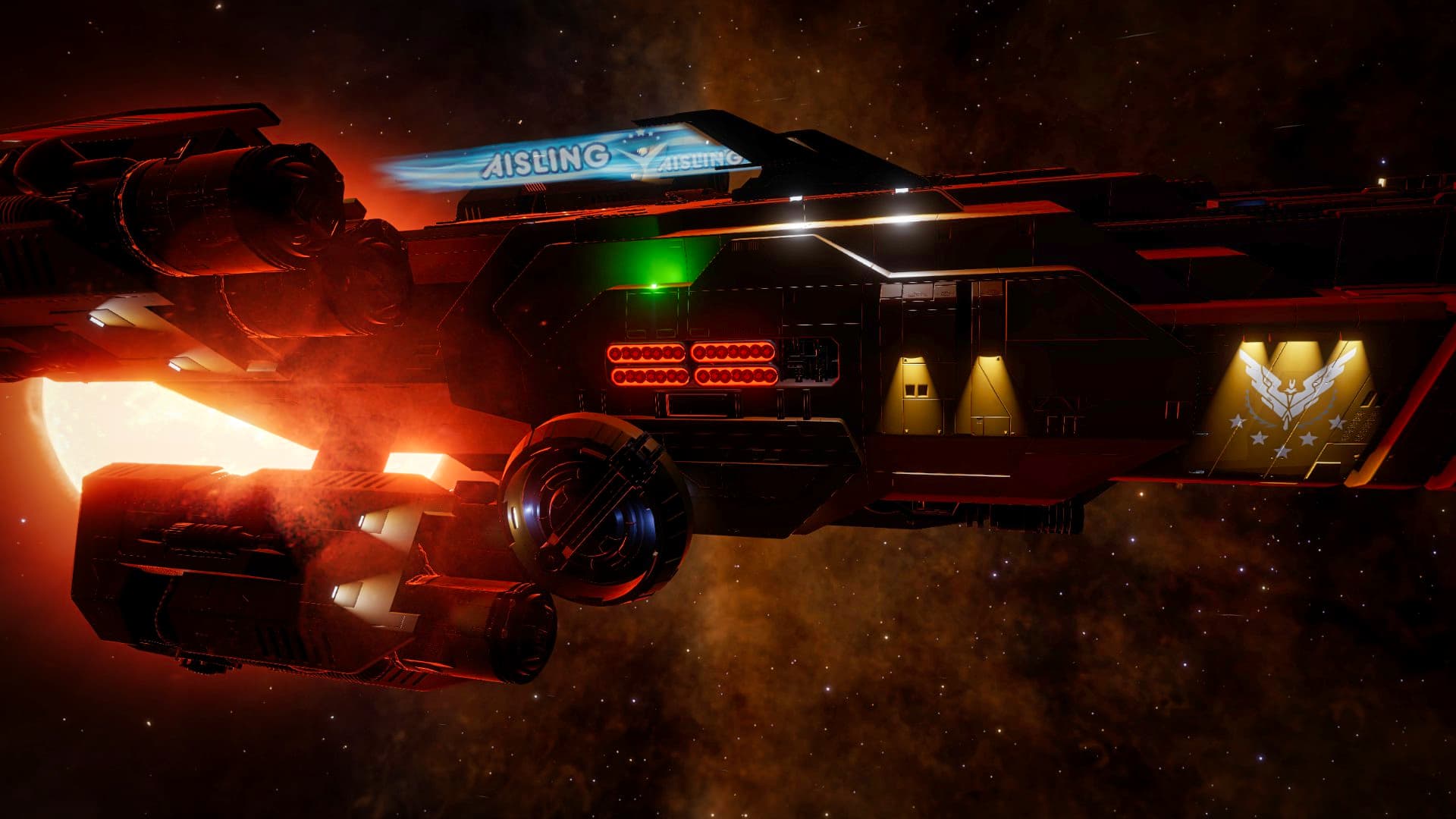
Elite Dangerous: Ascendancy is here, and it's packed with new toys to (power)play with. One of the most anticipated of those is the revamped PowerPlay system. Now that you have your hands on it, we want you to explore the changes and explain them. It's up to you whether you simply explain the new system, discuss key changes from the old system, and/or (most helpfully of all) provide tutorials to help players get to grips with it all.
Some elements to consider including:
An overview of how the system works
The powers themselves
What's new
How best to engage in the gameplay system
The differences between late-game and early-game engagement
How to take advantage of the changes
If there's an element of the system that you don't quite understand, it's better to admit that or leave it out rather than guess at it.
You can enter with text to win a $5 reward or you can enter with video for a $10 reward. If you enter with text, we'd love it if you submitted some complimentary images, ideally (though not essentially this time) verified via social media.
Elite Dangerous’ PowerPlay 2.0: understanding the basics
If you’re new to the game, you might be wondering what all the buzz is about regarding the latest update, which is said to bring major changes to game dynamics. In fact, these updates might even be what drew you to the game - unique in its style, though it shares themes with other games in the genre. On the other hand, you might be a seasoned player who took a break for whatever reason and has returned to check out the new ships and updates, now wondering: wait, was there even a PowerPlay 1.0?
We’ll break it all down shortly, but first, it’s important to note that the PowerPlay system has been around since 2015:
But it never quite lived up to its potential, not due to its complexity but rather the challenge of creating a rewarding and immersive system that encouraged commanders to engage in the galaxy’s political activities. For many years, PowerPlay was just a button on the galactic map that would color-code areas where Powers held influence. I myself became a commander in 2017 and took a while to realize I was ignoring a whole game mechanic—and even then, I didn’t engage with it.
But now, that seems to have finally changed. With the Ascendancy Update, the system has been reworked, not only doing justice to its potential but also making it far more inviting for commanders who value immersion and political gameplay. The Elite storyline has always been exciting, and now, commanders of all ranks can actively participate. There’s even talk that Powers might be removed from the game if they lose their systems or due to other events… but that’s just a rumor.
What we do know for sure is that there are better rewards—financial, equipment-based, and Power-exclusive perks. It makes sense, for example, that your Power would cover the costs of your ship losses in battles to defend it or if you're destroyed while mining in a controlled system. More than that, though, we’re being offered a new perspective on the territorial tug-of-war between Powers, which can now expand and must protect their territories more than ever.
There are six system states, as they are shown on the Galaxy Map, divided into two main categories:
Acquisition or Unoccupied systems:
Reinforced or Reinforcing systems (or simply, Control)
These general categories mean that a system is either unoccupied by any Power or in the process of being acquired by a Power—either through expansion or through contesting the control of an existing Power. The other category concerns Control, with stages like Reinforcing, where actions need to be taken to secure the system (or, conversely, Undermining, if a rival Power is contesting it), and Reinforced, marking the end of a conflict, regardless of which side prevails, a Reinforced Control system would belong to the winning Power if it's classified as Exploited. However, the losing Power might still maintain control if the system was at least Fortified - at least until another Power successfully undermines it repeatedly, potentially reducing it to Unoccupied status. Alternatively, if an Exploited system isn’t within the control range of a Fortified or Stronghold system, it may also revert to Unoccupied at the end of the weekly cycle.
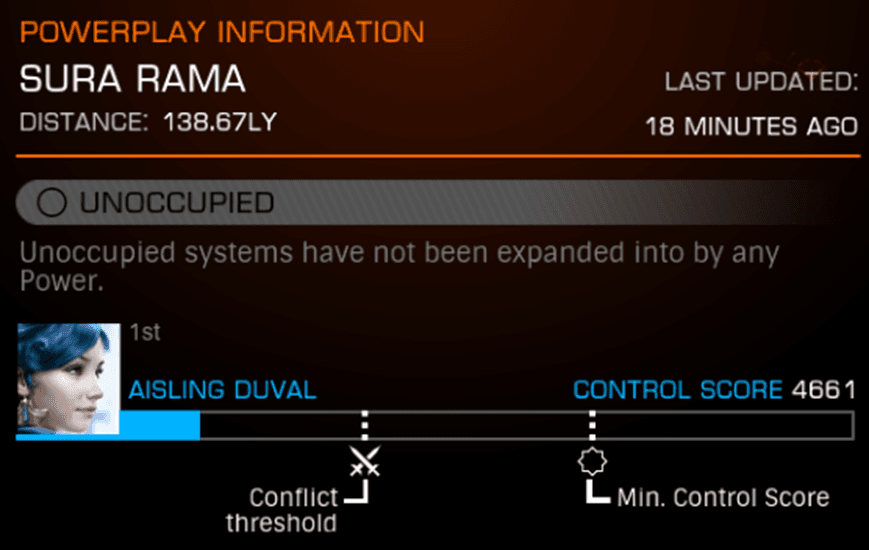
With these categories in mind, it’s easier to understand what each system type represents. In Unoccupied systems, no Powers are active, so they can still be targeted for expansion. If a Power meets the Conflict Threshold and Control Score, the system will shift to the Expansion state, meaning PowerPlay activities must be carried out for that Power to establish stable control. This is what Aisling Duval, for example, is currently attempting in a system:
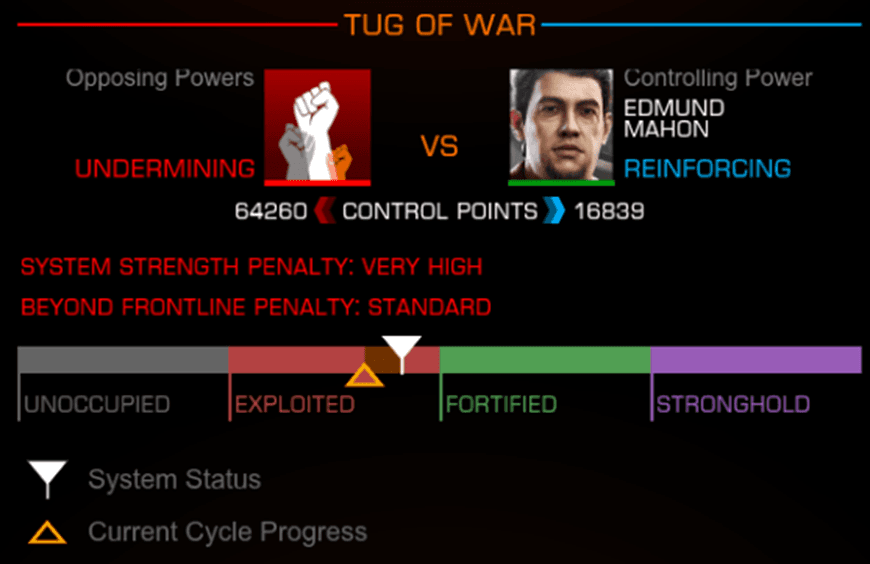
For controlled systems, there are the Exploited, which, like Expansion systems, need to be within the “control bubble” (20Ly) of a well-controlled system, such as a Fortified or Stronghold. Control mechanics are essential when it comes to territory disputes, determining the state of a system at the end of the weekly cycle. With stronger control, an Exploited system can become Fortified, enabling Power expansion into nearby systems, while a Fortified can turn into a Stronghold—the most secure state, accessible only to ships pledged to the controlling Power. You can monitor this dynamic on the PowerPlay panel of any selected system on the galaxy map, as shown in this example where Edmund Mahon is reinforcing an Exploited system but is losing (notice the Control Score/Points difference and the lower bar, with the yellow-bordered triangle representing the current stage of the dispute):
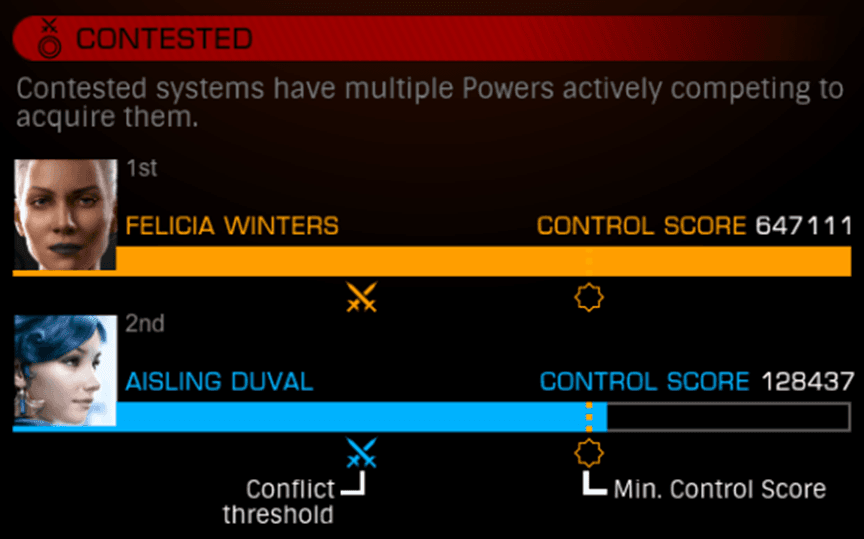
And, as one might expect, Contested systems are where territorial disputes are most intense, as two Powers are vying for Control over them. The system will become Exploited by the Power with the highest Control Score at the end of the weekly cycle. If you're looking for intense action, you'll most likely find it in the Contested systems:
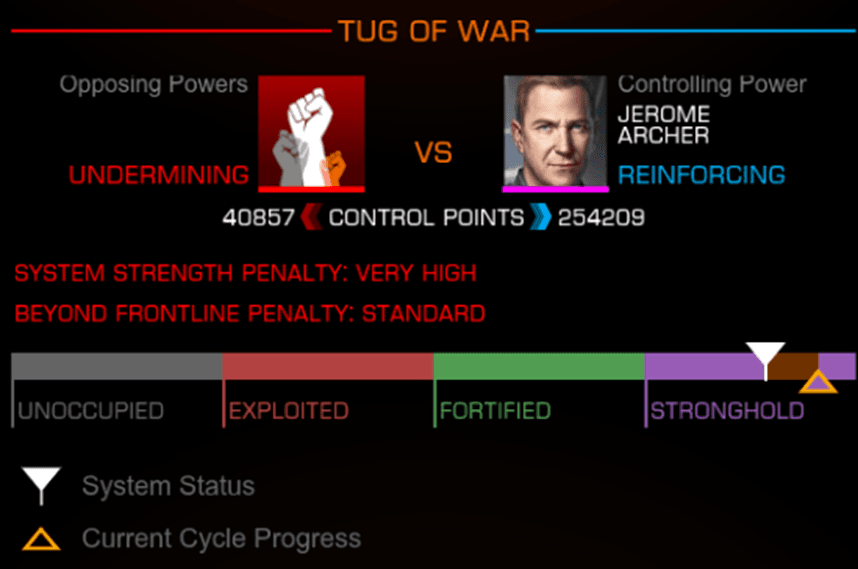
Even Stronghold systems can be “contested,” with the goal of weakening the controlling Power and downgrading it to Fortified, for instance:
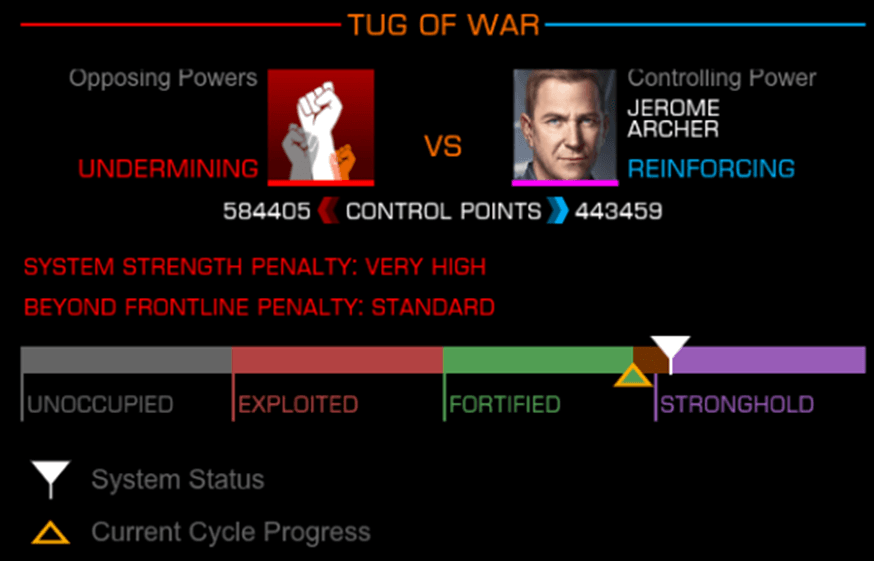
In this example, Jerome Archer is winning in Control, and by the end of the cycle, the system should be even more solidly under his control. However, in some cases, this can actually weaken the state of the system, as in this example:
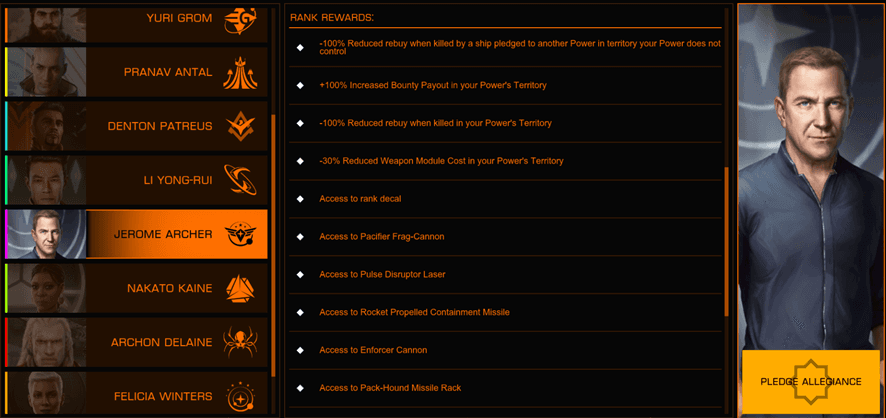
Another big change is the broader range of activities Commanders can engage in under PowerPlay, making nearly every in-game activity in ED beneficial to your pledged Power. Some mechanics can even benefit you more directly, like Jerome Archer, who offers a 100% bonus for bounties claimed in his systems:
Here’s a list of independent activity bonuses offered by each Power to their commanders:
Edmund Mahon: +50% Trade Bond on Rare Goods sales; +25% Trade Bond on sales.
Aisling Duval: +200% on Search and Rescue payout.
Arissa Lavigny-Duval: -30% on Weapon Module cost.
Yuri Grom: +15% on Exploration Data sales; +15% Trade Bond on sales; -30% Weapon Module cost.
Pranav Antal: +30% Organics Data sales; +50% Technology Commodities profits.
Li Yong-Rui: +100% Exploration Data sales; -100% Rearm prices; -100% Refuel prices; -100% Reduced Repair; +25% Trade Bond on sales.
Jerome Archer: -30% Weapon Module cost.
Nakato Kaine: +50% on Mining Commodities profits; +150% in Minor Faction Reputation gain; +120% on Search and Rescue payout.
Archon Delaine: +30% on Black Market profits.
Felicia Winters: +60% on Food and Medicine profits; +100% on Minor Faction Reputation gain; +100% on Salvage profits.
Zemina Torval: +45% on Mining Commodities profits; +50% on Imperial Slaves Commodity profits; +20% on Trade Bond on sales.
Remember, these perks only apply to actions performed in a system controlled by the respective Power. A new “Road to Riches”! Just imagine, by allying with Nakato Kaine, for instance, that 50-million platinum mining run becomes 75 million! Not to mention the bonuses in exobiology combined with discovery rewards.
Additionally, every Power offers access to all new special modules as you progress in Ranks, so don’t worry about which modules belong to each Power when making your choice; focus instead on which modules you want first, as the key difference lies in the order of module availability - and it’s no coincidence that Archer, focused on Bounty, offers military modules first as you earn Merits. Merits, by the way, are the “currency” you earn for PowerPlay-related activities, so aim to collect plenty of them.
So now you’re ready to experience PowerPlay 2.0… or to ignore it, as unpledged ships suffer almost no drawbacks. Almost none, because the only downside I’ve seen so far is that in Stronghold systems, you can be attacked if scanned, which can be annoying but makes sense, as access to such heavily controlled areas shouldn’t be open to everyone. That said, only about 40 systems in the Bubble are Strongholds, and you’ll only be attacked if you try to enter a Starport, which can be avoided with Heat Sinks or by activating Silent Running.
With these tips in mind, the choice is yours to pledge or not to the Power you choose. It’s an optional game mechanic, and you can play for hours without being affected. And if you are, well, you know how politics works…
Fly dangerously, CMDRs! o7
yan5743611/13/2024
Won$5
PowerPlay 2.0 brings a new approach to the political and strategic control of the space bubble in Elite Dangerous
PowerPlay 2 brings something new to the political and strategic control of the space bubble, with a system in which players can choose different “powers”, which are represented by leaders with different objectives. When we choose to support one of these figures, players help to expand and defend systems, earning merits and rewards. We have 12 powers and each one has its own specific advantage:
FEDERATION: Felicia Winters and Jerome Archer promote expansion and development.
EMPIRE: Led by Arissa Lavigny-Duval, Aisling Duval, Denton Patreus and Zemina Torval, they value imperialism.
ALLIANCE: Edmund Mahon and Nakato Kaine seek to protect their regions.
INDEPENDENT: Pranav Antal, Archon Delaine, Yuri Grom, and Li Yong-Rui operate autonomously.
What's new in PowerPlay 2.0
Merits are now cumulative on a weekly basis, which rewards long stays in a single power
System control layers: Systems can be in six states: uncontrolled, expanding, contested, exploited, fortified and fortress. The level of control directly influences the activities and challenges available.
JHenckes11/13/2024
Won$5
Remembering a little about what PowerPlay is, we have to know that it's a battle for territory: each power tries to expand into systems, extracting resources from them to pay for continued expansion and protecting the systems that are already being exploited.
So let's talk about PowerPlay 2.0. With the start of the new system, we now have 12 powers in the galaxy that represent the main participants in galactic politics, with each power influencing certain systems in the bubble. This way, as soon as you set loyalty to one of these powers, you can earn perks, bonuses and power specific modules from PowerPlay. The best thing here is to choose the Power that benefits you the most based on your style of play and type of gameplay!
Going even deeper into the details of each Power, let's talk about Ranks and Rewards: All Powers have 3 common benefits for all players, regardless of their choice (zero cost for repurchasing the ship in 2 specific contexts and access to the rank decal). Apart from these, each Power will have its own unique benefits that will usually favor the style of play that suits that Power, so it's important to choose carefully!
As for the modules, we have 12 types that can only be unlocked via PowerPlay, but rest assured that all Powers have access to all 12 modules, just changing the unlocking sequence of these modules. Okay, but how do these ranks work? As soon as you join a Power, you gain access to 5 activities, which, when completed, start to raise your rank. Each rank gives you more benefits, one example being care packages that have materials, component and credits. But the most important thing when you rank up is “Merit”, which will increase your power standing or decrease the power standing of another Power, and this has a total impact on your actions in certain systems such as selling materials. The main difference from PowerPlay 1 is that merits are now earned immediately and don't expire!
Another important thing about the new PowerPlay are the “System States” these include:
Unoccupied: No control of Powers;
Expansion: Your Power is trying to take control, but it hasn't succeeded yet;
Contested: Two Powers are actively vying for control;
Exploited: Systems that your Power has reached the lowest control limit;
Reinforced: When your Power has reached a new level of control;
Stronghold: Highest level of a Power's control.
NOTE: 1, 2 and 3 are Acquisition Systems while 4, 5 and 6 are Reinforcement Systems!
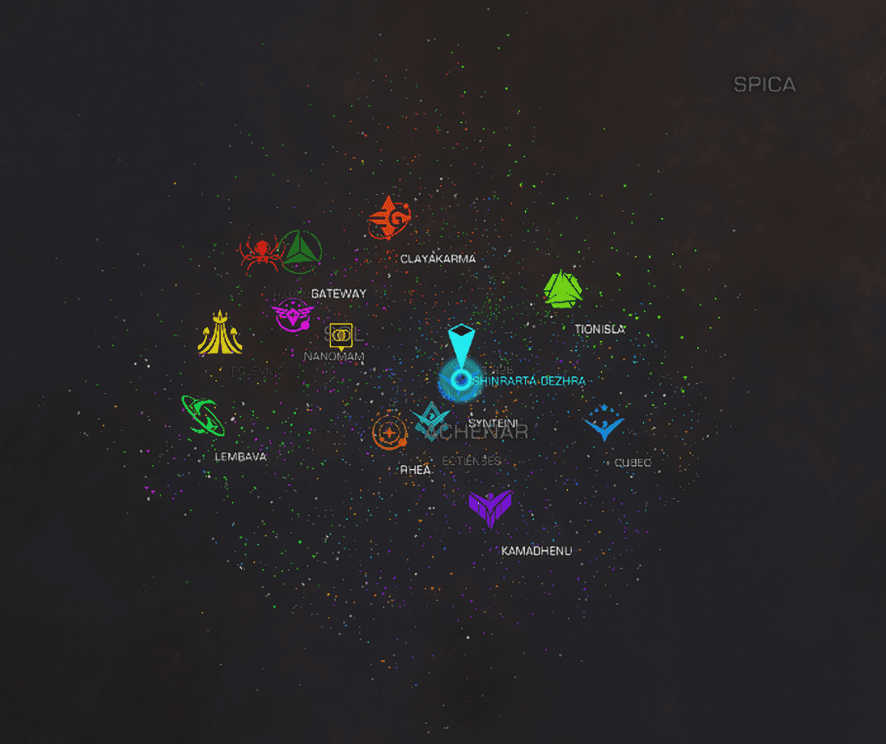
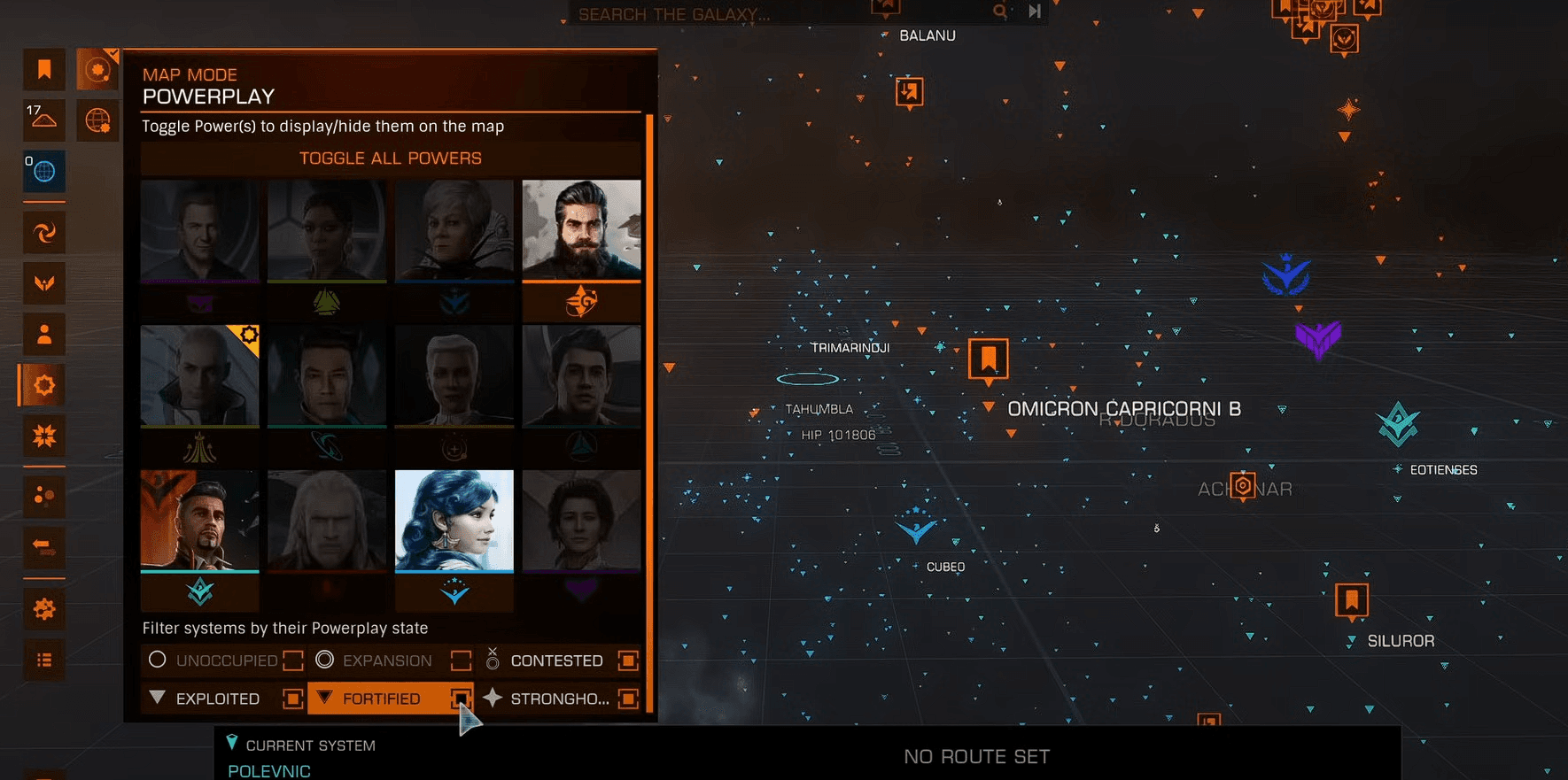
Now for a part that I liked a lot! The new PowerPlay 2.0 map. The control display for each Power has become much clearer and visually beautiful. What's more, it has the filter with the systems states that I explained just now, which makes it much easier to find what you need!
With these tips on how the new system works, I think it will be easy to start the rank tests! Good luck!
R
Randomgazz11/13/2024
Won$5
Step 1: Pledge to the power of your choice through the right hand panel.
Step 2: Find and complete the assignments either through the power menu or the transactions tab.
Step 3: You can now earn ranks and will progress as you collect merits - currently rare trading or collecting escape pods pays the best.
Step 4: Spread your power across the galaxy!
I suggest joining your Power discord to work with like minded CMDRs to greater effect.
Hunter11/13/2024
Won$10
Simple Guide for Powerplay 2.0 and its new additions :